Introduction
Every AI initiative eventually runs into the same wall: data gravity. Training sets, model checkpoints, embeddings, logs, and analytical datasets are overwhelmingly unstructured — and they grow faster than any other class of enterprise data. Where that data lives, and how portably it can be accessed, quietly determines what your AI roadmap can actually deliver.
Object storage has become the default substrate for this world, and MinIO is one of the strongest ways to own that layer yourself. MinIO is a high-performance, Kubernetes-native object storage solution built to handle large volumes of unstructured data — AI/ML workloads, data lakes, and analytics — while speaking the same S3 API the entire modern data ecosystem already understands.
Why Object Storage for AI/ML
File systems and block volumes were designed for a different era. Object storage scales horizontally, addresses data by key rather than by path, and attaches rich metadata to every object — exactly the access pattern that data lakes, feature stores, and model registries need.
- Effectively unlimited, flat-namespace scale for training corpora and streaming telemetry.
- HTTP-native access that every ML framework, Spark job, and BI engine can consume directly.
- Immutability, versioning, and object locking for reproducible experiments and auditable pipelines.
- Cost-efficient tiering — hot NVMe for active training data, colder tiers for archives and checkpoints.

MinIO: Kubernetes-Native by Design
MinIO deploys as lightweight containers orchestrated by Kubernetes, which means storage finally follows the same operational model as the applications it serves — declarative manifests, rolling upgrades, horizontal scaling, and GitOps-friendly configuration.
Performance is the other half of the story. MinIO's erasure-coded, parallelized architecture is engineered to saturate modern NVMe and 100 GbE hardware, keeping GPUs fed during training instead of starving them behind a slow storage tier.
- S3-compatible API — drop-in target for TensorFlow, PyTorch, Spark, Presto/Trino, Iceberg, and Delta Lake.
- Erasure coding and bitrot protection for durability without RAID complexity.
- Server-side encryption, IAM-style policies, and STS credentials for fine-grained access control.
- Active-active replication between sites, regions, and clouds.
The Multi-Cloud and Hybrid Pattern
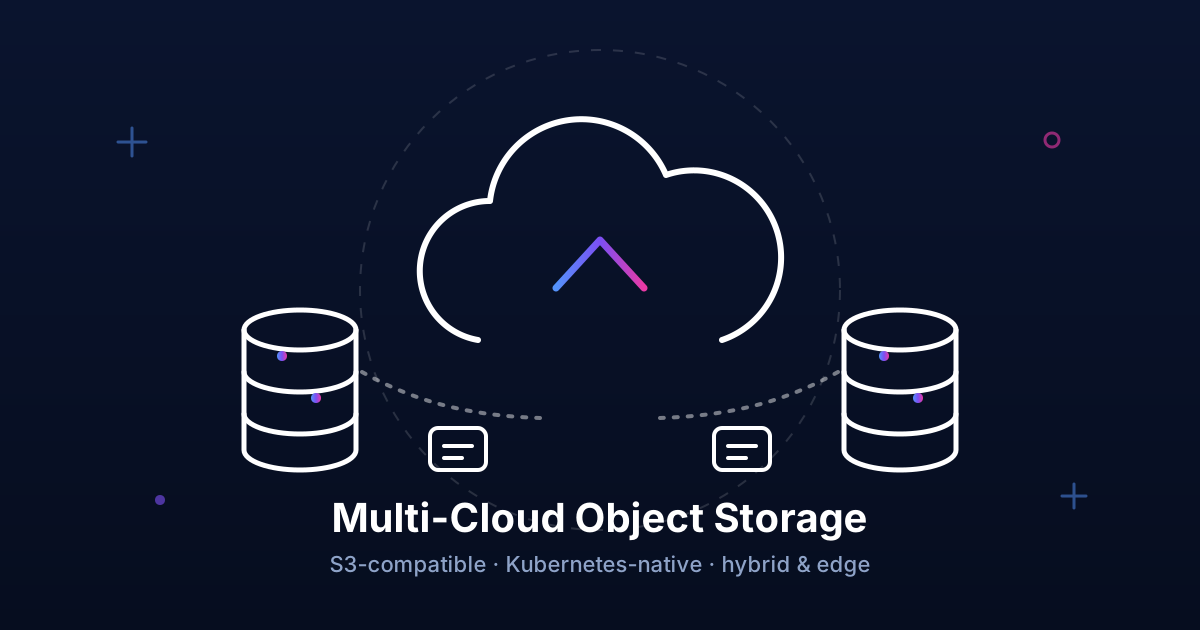
Multi-cloud is rarely a goal in itself — it is the consequence of real constraints: data-residency rules, GPU availability, acquisition inheritance, negotiating leverage, and edge locations that are nowhere near a hyperscaler region.
The winning pattern is a consistent storage abstraction everywhere: one S3-compatible API on-premises, in each public cloud, and at the edge. MinIO makes that abstraction something you own. Applications write to 'the object store' — not to a specific vendor — and replication policies decide where bytes physically live.
- Hybrid: keep sensitive or regulated datasets on-premises while bursting compute to the cloud against replicated read-only copies.
- Multi-cloud: train where GPUs are available and affordable; serve where your users are — same buckets, same tooling.
- Edge: capture and pre-process data close to the source, then replicate curated sets to core data lakes.
- Exit-ready: because the API is S3 everywhere, no pipeline is welded to any single provider.
How @RitS Applies This
In our engagements, the storage layer is designed before the model layer. We stand up MinIO on Kubernetes as the common object substrate, wire it into the data-ingestion and RAG pipelines we build for clients, and apply zero-trust principles — per-workload credentials, bucket-scoped policies, and encryption in transit and at rest — from day one.
The result is an AI data platform that is fast enough for training, portable across environments, and compliant by construction — turning storage from an afterthought into a strategic asset.
Want to explore what this could do for your business?
Talk to us