
Introduction
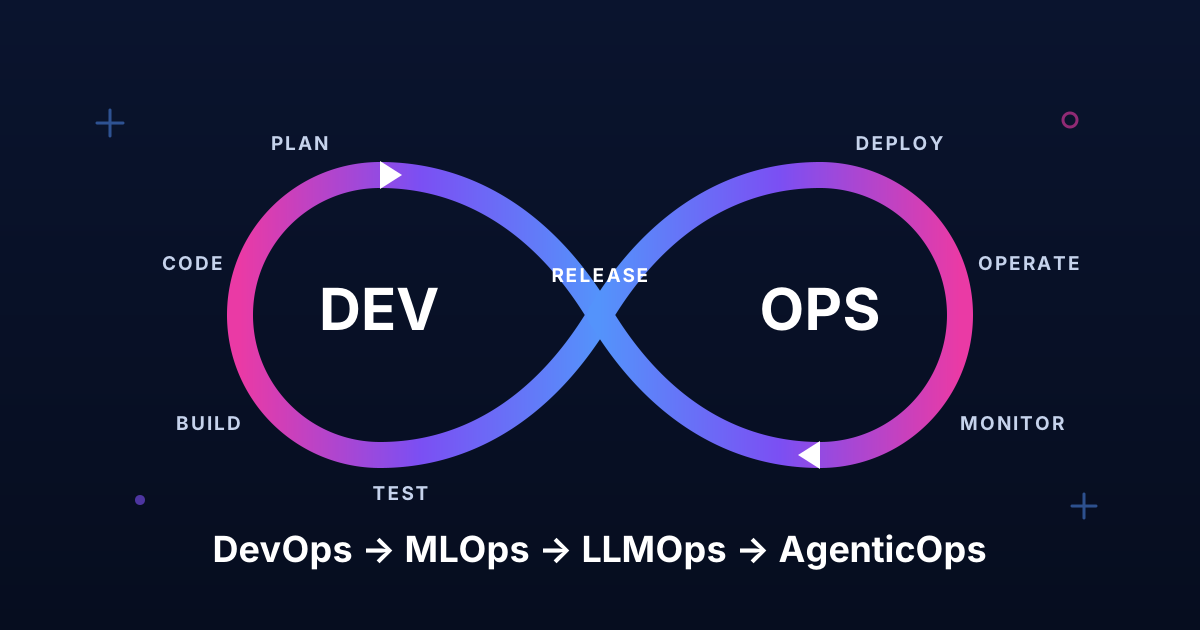
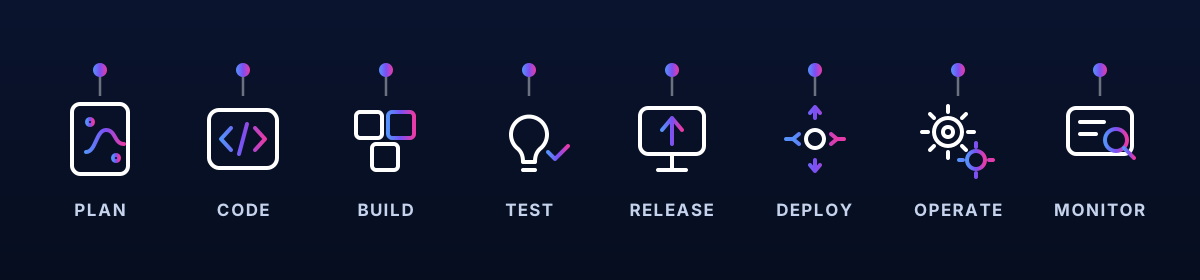
DevOps collapsed the wall between building software and running it, expressed in the familiar infinite loop: plan, code, build, test, release, deploy, operate, monitor. As machine learning, large language models, and now autonomous agents entered production, that loop didn't get replaced — it got specialized. Each descendant keeps the automation-first DNA while adding artifacts the original loop never had to manage.
DevOps: The Foundation
Everything downstream inherits from the same foundations: version control as the single source of truth, CI/CD pipelines as the only path to production, infrastructure as code, and observability closing the loop from operations back into planning.
MLOps: When the Artifact Is a Model
Machine learning adds artifacts that classic pipelines never handled: datasets, features, and trained models — each needing versioning, lineage, and validation of its own.
- Data and feature pipelines with the same rigor as code: versioned, tested, reproducible.
- Experiment tracking and model registries so any production model can be traced to its exact data and training run.
- Continuous training (CT) alongside CI/CD — retraining triggered by data drift, not just code change.
- Production monitoring for drift and model quality, not just uptime and latency.
LLMOps: Operating Language Models
Large language models shift the center of gravity from training to adaptation and inference. The 'source code' now includes prompts, retrieval indexes, and fine-tuning datasets — and quality is no longer a single accuracy number.
- Prompt and template versioning with regression evaluation on golden datasets.
- RAG pipeline operations: embedding refreshes, index rebuilds, retrieval-quality metrics.
- Inference economics: token budgets, caching, routing between small and frontier models.
- Safety evaluation and guardrails as release gates, not afterthoughts.
AIOps: AI Operating the Platform
AIOps flips the direction: instead of operating AI, it applies AI to operations itself. Telemetry volumes long ago outgrew human attention spans; AIOps uses anomaly detection, event correlation, and increasingly LLM-powered runbooks to compress detection and diagnosis from hours to minutes — with automated remediation for the well-understood failure modes.
AgenticOps: Operating Autonomous Agents
AgenticOps (Agentic Operations) refers to the shift where autonomous AI agents manage, plan, and execute IT, cloud, and software development workflows instead of just assisting humans.
Operating such systems is the newest discipline on this ladder: fleets of agents that plan, call tools, and cooperate. Everything from MLOps and LLMOps still applies — plus concerns unique to autonomy.
- Full-trajectory observability: every plan step, tool call, and inter-agent message traced and auditable.
- Evaluation of outcomes, not just outputs — did the multi-step task actually succeed, safely, at acceptable cost?
- Budget and blast-radius controls: caps on spend, loop depth, and action scope per agent run.
- Human-in-the-loop gates and instant kill-switches for high-impact actions.
The Common Thread: Least Privilege
The Principle of Least Privilege (PoLP) is a core cybersecurity practice: users, programs, and systems should be granted only the minimum level of access — or privileges — necessary to perform their assigned tasks. It restricts unnecessary access to sensitive data and critical systems, and it applies with increasing force at every rung of this ladder.
In DevOps it scopes pipeline credentials; in MLOps it separates data-science access from production model registries; in LLMOps it fences what retrieval pipelines may index and what tools a model may invoke; in AgenticOps it becomes existential — an autonomous agent with excess privilege is an incident waiting to happen. Scoped, short-lived, auditable access per agent and per tool call is what makes autonomy safe to operate.
@RitS, we treat these disciplines as one continuum: the same zero-trust, automation-first engineering culture, extended to every new kind of artifact that ships to production.

Want to explore what this could do for your business?
Talk to us